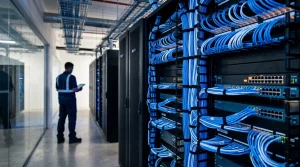

Let’s talk about the "dirty secret" of the tech world. Everyone loves to talk about the sexy stuff: AI-powered video analytics, autonomous building controls, and lightning-fast Wi-Fi 7. But here’s the truth: none of that matters if your cabling is a mess.
In 2026, the gap between a "smart building" and a "frustrating building" isn't the software you buy. It’s the physical infrastructure that carries the signal.
The low voltage contractor you choose today isn't just pulling wire; they are laying the nervous system for your entire business operation. Whether you’re running a healthcare facility, a fast-paced retail chain, or a corporate headquarters, your tech stack is only as strong as its foundation.
The Backbone of the 2026 Smart Building
We’ve moved past the era where "low voltage" just meant phone lines and a few security cameras. Today, it’s the primary delivery system for almost every essential business function.
As we look toward the end of 2026, smart buildings are becoming the standard, not the exception. This means your HVAC, lighting, security, and data networks are all talking to each other. This level of seamless integration requires a contractor who understands how these systems intersect.
- IoT Density: By 2026, the number of connected IoT devices in commercial spaces is expected to skyrocket. Each sensor needs a reliable path to the network.
- Data Throughput: With high-definition 4K surveillance and real-time data processing, your "standard" Cat5e cabling just won't cut it anymore.
- Scalability: A specialized contractor doesn't just build for what you have now; they build for the hardware you’re going to buy in 2028.

PoE and the "Death" of the Traditional Power Outlet
If you haven't heard of Power over Ethernet (PoE), you're already behind. PoE allows a single cable to provide both data connection and electric power to devices like wireless access points, IP cameras, and even LED lighting.
According to IEEE standards, PoE technology is evolving to deliver even higher wattage, meaning more of your facility’s equipment can run off your network cabling instead of traditional high-voltage electrical lines.
Why does this matter for your 2026 tech stack?
- Cost Efficiency: You don't need a high-voltage electrician to run a dedicated outlet to every single camera or sensor.
- Flexibility: Moving a device is as simple as moving a network cable.
- Centralized Control: Since the power comes from your network switches, you can reboot or manage power to devices remotely.
However, PoE generates heat within cable bundles. If your low voltage contractor doesn't understand proper bundle management and heat dissipation, you’re looking at a fire hazard or at the very least, a massive drop in network performance.
OT Security Starts at Layer 1
Security is no longer just about firewalls and passwords. In 2026, we are heavily focused on Operational Technology (OT) Security. This refers to the hardware and software that detects or causes a change through the direct monitoring and control of physical devices: think of your elevators, smart locks, and industrial controllers.
A specialized low voltage contractor understands that the physical layer (Layer 1 in the OSI model) is the first line of defense.
- Physical Separation: Ensuring that guest Wi-Fi and critical building controls aren't running on the same unshielded physical paths.
- Shielding: Using Shielded Twisted Pair (STP) cables in areas with high electromagnetic interference to prevent data corruption.
- Redundancy: Building in physical "fail-safes" so that if one line is cut, your security system stays online.

The 2026 Shift: Compliance and the "Limited Energy" Evolution
If you want to know if your contractor is an expert or just a "cable guy," ask them about the NEC 2026 code changes.
The National Electrical Code (NEC) is shifting its terminology, moving away from just "low voltage" to a broader "limited energy" framework. This isn't just a name change; it involves new safety standards for how power and data are combined.
Managing these regulatory shifts is a core part of what we do at Integrated Solution Services. We stay ahead of compliance and licensing requirements so you don't have to deal with failed inspections or costly retrofits later.
Why a Specialized Partner Beats a Generalist
You might be tempted to let your general electrician handle the data cabling. While they are great at high-voltage power, low voltage is a different beast entirely.
Precision is everything. A single kink in a fiber optic line or a poorly crimped RJ45 connector can cause intermittent network drops that are a nightmare to troubleshoot. A specialized low voltage partner brings:
- Advanced Testing Tools: We don't just "see if the light turns on." We use high-end fluke testers to certify that every line meets the required decibel and speed standards for your 2026 tech.
- Documentation: You get a full map of your infrastructure. No more guessing which wire goes where in the server closet.
- Holistic View: We look at how your cabling supports your construction projects and your long-term facilities maintenance goals.

Future-Proofing Your Business
The goal isn't just to be ready for 2026; it's to be ready for whatever comes next. Whether it’s the widespread adoption of Wi-Fi 7, more complex predictive maintenance sensors, or fully integrated AI building managers, your wiring is the bottleneck or the bridge.
Don't let your technology be held back by subpar infrastructure. When you choose a partner like Integrated Solution Services, you’re getting over 30 years of collective expertise in making sure the "hidden" parts of your business are the most reliable.
Ready to build a better foundation?
At Integrated Solution Services, LLC, we specialize in the seamless integration of technology, maintenance, and construction. Whether you're renovating an old space or building a new one, we make sure your low voltage infrastructure is ready for the future.
Contact us today to discuss your next project.