
Let’s be real: running a Quick Service Restaurant (QSR) in 2026 is basically like running a tech company that just happens to serve great chicken or burgers. You’ve probably dropped a small fortune on digital kiosks, AI-driven drive-thrus, and integrated POS systems.
But if you’re looking at your balance sheet and wondering why all that "innovation" hasn't translated into a massive ROI boost, you’re not alone. In fact, research shows that nearly one in five QSR employees experience tech issues at least weekly. When your technology fails, it doesn't just annoy the staff: it kills your margins.
If your tech feels more like a burden than a booster, here are the 10 most common reasons why: and how we fix them.
1. Your Systems Are Talking Different Languages (The Silo Effect)
The biggest ROI killer is the lack of integration. If your kitchen display system (KDS) isn't perfectly synced with your mobile ordering app, and your inventory management software is a complete stranger to your POS, you’re losing money.
When systems don’t talk, your staff has to act as the "translator," manually entering data or double-checking orders. That’s wasted labor. True ROI comes from a seamlessly integrated technology ecosystem where data flows from the front counter to the back office without a hitch.
2. You’re Treating the Drive-Thru Like an Afterthought
For most QSRs, the drive-thru is the lifeblood of the business, often accounting for 70% or more of total sales. Yet, it’s often where the oldest tech lives. From glitchy timers to headsets that sound like they’re underwater, drive-thru tech failures lead to longer wait times and "drive-offs."
Common drive-thru issues include timer errors that miss cars and payment processing glitches. If you aren't leveraging AI video analytics to monitor speed of service and identify bottlenecks in real-time, you’re leaving money on the pavement.

3. The "Cable Spaghetti" Behind the Counter
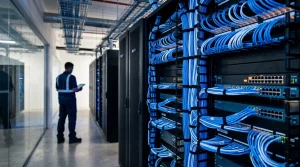
It’s the dirty little secret of QSR tech: the infrastructure. You can buy the most expensive AI software on the market, but if it’s running on a 10-year-old router and a mess of unorganized low-voltage cabling, it’s going to fail.
Poor network infrastructure leads to "ghost" outages where the system just… stops. This results in employees having to pause their duties to play IT support. Proper low-voltage cabling and infrastructure are the literal backbone of your ROI. If the foundation is shaky, the house will fall.
4. You’re Reactive Instead of Proactive
Are you calling for repairs only when the fryer goes down or the POS screen goes black? That’s the most expensive way to run a business. Emergency repairs come with premium price tags and, more importantly, lost sales during downtime.
The fix? Predictive and proactive facilities maintenance. By scheduling regular check-ups on your tech and hardware, you extend the life of your assets and ensure that a $50 part doesn't turn into a $5,000 lost Friday night.
5. Over-Complicating the Customer Journey
Sometimes, more tech isn't better tech. If your self-service kiosks have ten different screens just to order a soda, customers will get frustrated and head to the counter: or worse, the competitor across the street.
Technology should remove friction, not add it. ROI increases when tech makes the ordering process faster and more intuitive. If your customers are struggling to navigate your UI, your "labor-saving" kiosk is actually just a very expensive paperweight.
6. Ignoring the "Human Element" (Employee Buy-In)
We’ve seen it a hundred times: a corporate office rolls out a shiny new tablet system, and three weeks later, the tablets are sitting in a drawer because the staff hates them.
If your team feels like the technology is making their jobs harder, they won’t use it correctly. ROI is tied to adoption. You need to choose tech that is user-friendly and provide the training necessary to make your team feel like tech-superheroes, not tech-slaves.

7. Choosing Tech That Doesn't Scale
What works for a single-unit "mom and pop" shop rarely works for a 50-unit franchise. Many QSR owners get stuck with "prosumer" grade tech that can’t handle the heavy-duty traffic of a busy commercial environment.
When you're planning a new build or renovation, you need to look at technology through the lens of scalability. If it doesn't work across your entire portfolio with centralized management, it’s going to become a management nightmare as you grow.
8. Data Overload Without Actionable Insights
Most modern POS systems give you mountains of data. But data isn't ROI: insights are. If you’re staring at a spreadsheet of 500 different metrics but can’t tell why your food waste is up 4% this month, the tech isn't doing its job.
The fix is to work with a technology provider that helps you set up dashboards that matter. You need to know:
- Average transaction time per station.
- Peak hour bottlenecks.
- Real-time inventory vs. sales.
- The actual "cost to serve" per order.
9. Hidden "Tech Debt" and Maintenance Costs
When you bought that new digital signage, did you factor in the cost of content updates, hardware refreshes, and inevitable repairs? Many QSRs suffer from "Tech Debt": the cumulative cost of maintaining aging or poorly implemented systems.
To fix this, you need a comprehensive facilities maintenance strategy that treats your technology as a critical asset, not just a one-time purchase.
10. Partnering with the Wrong People
Perhaps the biggest reason tech doesn't deliver ROI is that it was installed by someone who doesn't understand the QSR environment. A general IT guy might know how to set up a laptop, but does he understand the heat, grease, and high-velocity demands of a commercial kitchen?
You need a partner who understands the "Triple Threat" of Construction, Facilities, and Technology. At Integrated Solution Services, LLC, we’ve spent 30+ years helping commercial entities integrate these three pillars so they actually work together.

How to Fix It Today
If your technology is currently a headache instead of a profit-driver, it’s time to stop the bleeding.
- Audit Your Infrastructure: Check your cabling and network. Is it built for 2026, or 2016?
- Integrate or Evict: If a piece of tech doesn't talk to the rest of your stack, it might be time to find a replacement that does.
- Go Proactive: Stop waiting for things to break. Move to a proactive maintenance model.
Technology should be the wind in your sails, not an anchor dragging you down. By focusing on integration, reliability, and the customer experience, you can turn those "tech costs" into genuine, measurable ROI.
Ready to stop guessing and start growing? Contact us today to see how we can streamline your QSR operations.